
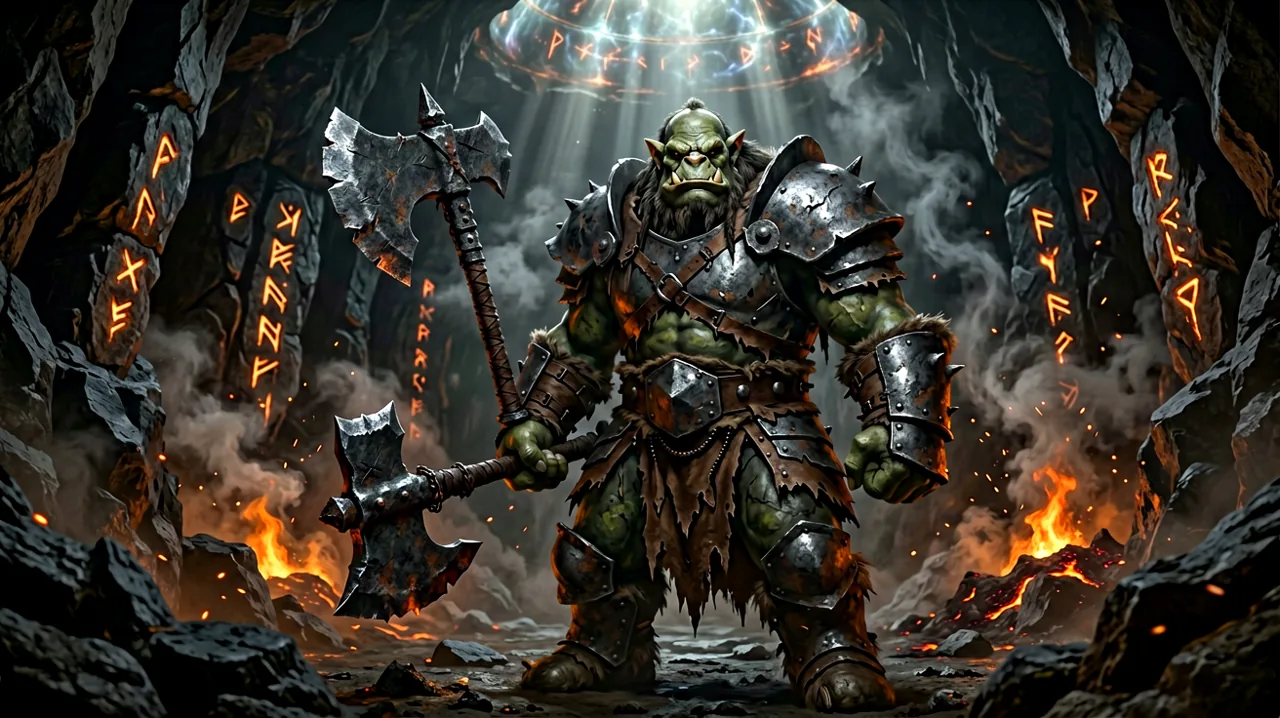
For decades, the Orcs of the Valley of Mines were perceived by most players as little more than brutal, bloodthirsty monsters acting as the ultimate obstacle to the Nameless Hero’s escape. While the original 2001 classic hinted at a much deeper culture—evidenced by the exiled shaman Ur-Shak and the enslaved Tarrok—their spoken dialogue was largely incomprehensible. Fast forward to the highly successful release of the Gothic 1 Remake by Alkimia Interactive, and the colony’s most formidable inhabitants have received a massive, underlying overhaul.
Recently, dedicated players have made a groundbreaking discovery: the Orcs aren’t just making aggressive guttural noises when they spot you in the forests. They are speaking a fully functional constructed language (conlang). This revelation not only highlights the development team’s intense dedication to world-building but also provides a completely new layer of immersion for fans exploring the colony.
The Conlang Revelation: Breaking Down the Beast
Community member /u/The_Blacks2000 recently took to Reddit and the World of Gothic forums to share the results of a massive linguistic project. After weeks of meticulously transcribing and analyzing all available in-game audio and text associated with the Orc factions, the community has confirmed that Alkimia Interactive went to extraordinary lengths to flesh out this ancient race.
The audio barks, combat taunts, and ambient conversations overheard when sneaking near Orc patrols are built on a consistent, rule-based linguistic framework. It is not just randomized sound effects stitched together to sound menacing. The community linguist has managed to decode over 140 distinct words, successfully reverse-engineering the grammar and syntax of the Orcish tongue.
Grammar and Morphology: How Orcish Works
According to the extensive documentation published on the World of Gothic forums, the Orcish language in the Gothic 1 Remake utilizes a Subject-Verb-Object (SVO) sentence structure. For English speakers, this is a highly familiar framework (for example, “I [Subject] swing [Verb] the axe [Object]”). This specific structural choice by the developers makes the language logically decipherable without sacrificing its alien, harsh, and primitive acoustic qualities.
Furthermore, the morphology of the language is highly systematic. The vocabulary relies heavily on fixed root words. In constructed languages, this usually means that complex ideas are expressed by combining foundational concepts—a very logical reflection of a tribal, pragmatic society focused heavily on survival, warfare, and spiritual worship. If you know the root word for “magic” and the root word for “human”, you might be able to piece together their term for the Fire Mages in the Old Camp.
The community’s breakdown also outlines specific rules for forming plurals and negations. This conclusively proves that every grunt, shout, and murmured prayer heard in the Orc City was carefully scripted, translated into this conlang, and voiced by the development team.
From 2001 to 2026: Elevating the Orcish Culture
Veterans of the original Gothic will remember that understanding the Orcs was entirely impossible without narrative intervention. Your interactions were strictly limited to a few named characters who happened to speak human languages. We already knew from the classic lore that the Orcs possessed a complex societal hierarchy—divided clearly into fighters, elites, shamans, and slaves—and a deep religious fervor centered around the arch-demon Krushak, known to humans as the Sleeper.
Alkimia Interactive’s decision to implement a real conlang elevates the Orcs from mere high-level enemy mobs to a grounded, authentic civilization. This aligns perfectly with the remake’s broader design philosophy: expanding the lore of the Valley of Mines without breaking the established canon. We’ve already seen how the developers expanded on the visual storytelling with the mysterious Orc runes in the Sleeper’s Temple, and this spoken language translation acts as the perfect companion piece to that environmental detail. The culture of the Orcs is no longer just told to the player; it is woven into the very fabric of the game’s audio design.
Practical Gameplay Implications for the Nameless Hero
But what does this mean for the actual gameplay experience? For most players, a massive Orc Elite charging at you with a heavy weapon is universally understood, regardless of the language barrier. However, for those looking to immerse themselves completely, this linguistic breakthrough adds a fresh layer of tension to exploration.
When you are navigating the treacherous mountain paths toward the Orc City in Chapter 5, or trying to avoid aggressive patrols in the late-game forests, listening to the ambient dialogue takes on new meaning. While not officially confirmed as a mandatory gameplay mechanic, players who study the community’s dictionary might find themselves recognizing patrol shifts, warnings, or combat tactics being called out by the Orcs in real-time. It transforms a generic enemy bark into a valuable tactical audio cue.
Furthermore, this drastically enriches the pivotal quests involving the Orcs. When you finally encounter Tarrok in the Free Mine and begin the intricate Ulu-Mulu questline, his dialogue and the cultural significance of the artifact feel substantially heavier when you realize the depth of the language his people speak. The same applies to Ur-Shak, the exiled shaman who provides critical exposition about the Sleeper’s origins. Knowing that they possess a rich language of their own makes their willingness to communicate with the Nameless Hero in a human tongue feel like a significant diplomatic effort.
The Ongoing Debate: Is the Remake Accessible for Newcomers?
While veteran players are busy deciphering ancient tongues and mapping out the Orcish dictionary, an entirely different conversation is dominating other sections of the community. The influx of new players, attracted by the stunning Unreal Engine 5 visuals and dark fantasy atmosphere, often hits a steep learning curve. Recent community threads show newcomers repeatedly asking variations of a simple question: “Is this game worth it, and how does its difficulty compare to modern franchises like Dragon Age?”
The short answer provided by the hardcore community is that the Gothic 1 Remake is fundamentally different in its approach to challenge. Unlike most modern RPGs where the world dynamically scales to the player’s level to ensure a smooth, cinematic experience, the Valley of Mines is a static, dangerous ecosystem. If you wander into the wrong forest at level 3, a Shadowbeast or an Orc patrol will decimate you without a second thought. The difficulty isn’t just about reflex-based combat; it is about knowledge, preparation, allocating your Learning Points wisely, and respecting the environment.
This lack of hand-holding is exactly why features like the constructed Orcish language exist. The game demands total immersion. You are not a pre-destined chosen one—you are a scrawny prisoner who must earn every scrap of magic ore, every rusty sword, and every ounce of respect from the factions detailed in our Three Camps guide.
For a newcomer coming from the power-fantasy of modern RPGs, the initial hours of the Gothic 1 Remake can feel punishing. However, the community consensus is clear: the payoff is immense. The sense of progression—going from being bullied by a single Scavenger to standing toe-to-toe with an Orc Warrior—is unmatched in the genre. Understanding that the world operates on its own rules, with its own languages and ecologies, is the key to surviving and eventually thriving under the Barrier.
What’s Next for the Orcish Dictionary?
The current vocabulary list of 140 words is likely just the beginning of this community initiative. As more players reach the deep endgame and thoroughly explore the subterranean depths of the Sleeper’s Temple, we can expect additional audio files to be documented and analyzed. The researchers are actively calling for players to record and submit any unusual Orc dialogue they encounter, particularly during late-game combat encounters, rare idle animations, or specific interactions with shamans.
If you are currently grinding out your levels and preparing to brave the dangerous Orc territories, taking a moment to review the community dictionary on the World of Gothic forums might not physically boost your armor rating, but it will undeniably enhance your journey through the colony. Alkimia Interactive has built a world that rewards those who pay attention to the details, and deciphering the language of your enemies is the ultimate proof of that design philosophy.