
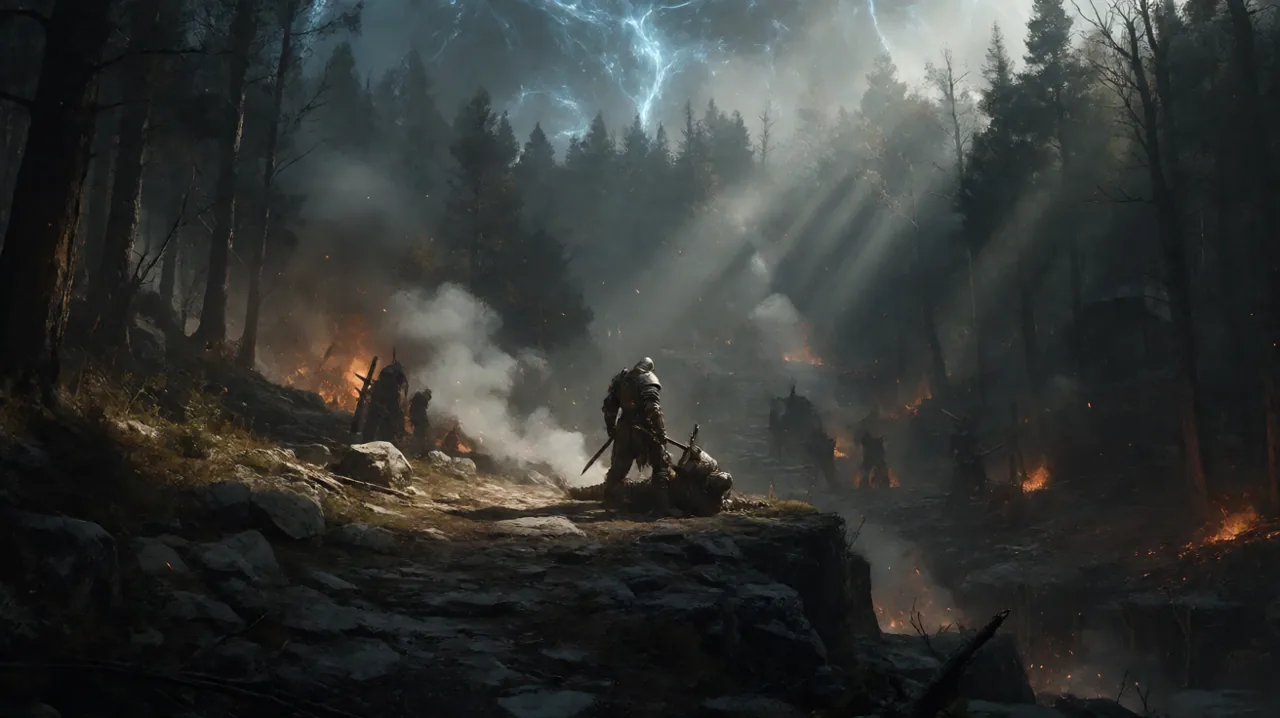
The release of the Gothic 1 Remake has revitalized a passionate, decades-old community. Players are returning to the Valley of Mines not just to relive their childhoods, but to push the modernized mechanics of Unreal Engine 5 to their absolute breaking points. Over the past weekend, two distinct conversations have dominated the community forums: a mind-boggling mechanical achievement by a console player, and a nuanced narrative debate regarding the game’s later chapters.
While some players are treating the game as a mathematics puzzle to be optimized, others are reflecting on the structural pacing of the Colony and what it means to be a “faithful” remake.
The Mathematical Madness of Level 32
In a standard playthrough of the Gothic 1 Remake, most players will finish the game and face the Sleeper somewhere between level 35 and 40. Hitting level 10 before choosing one of the three camps is generally considered a solid, thorough start.
However, a dedicated PS5 player recently shared a screenshot on the World of Gothic subreddit showcasing their Nameless Hero sitting at an astronomical Level 32—all before officially joining a guild in Chapter 1. This achievement has left many casual players scratching their heads, wondering how the game’s finite economy even supports such a feat.
Achieving this requires a systemic exploitation of every single mechanic the game has to offer. First, the player must navigate the complex web of admission quests. The Remake allows you to complete nearly all the prerequisite tasks for the Old Camp, the New Camp, and the Swamp Camp simultaneously. You can run errands for Thorus, hunt with Cavalorn, distribute weed for Baal Kagan, and help the Rogues, soaking up massive amounts of quest XP right up to the final dialogue prompt where you officially swear allegiance.
But quests alone won’t get you anywhere near level 32. To level up fast to this extreme degree, players have to engage in what the community affectionately calls the “Pacifist Knockdown Strategy.”
The Pacifist Knockdown Strategy
One of the defining mechanics of the Gothic universe is the ability to engage in non-lethal melee combat. If you strike down a human NPC with a melee weapon, they don’t die; they fall unconscious. While they are down, you can loot their weapons and their raw ore, and more importantly, you receive the full combat XP for defeating them.
To reach level 32 in the guildless phase, a player must systematically beat down almost every non-essential, non-lethal NPC across the entire map. This is a grueling, highly calculated process. You must carefully pull individual diggers, rogues, and novices away from the heavily armed guards. Using basic, unrefined weapons to avoid accidentally executing them, players spend dozens of hours engaging in back-alley brawls.
You memorize patrol routes, exploit line-of-sight mechanics, and slowly drain the colony’s population of their pride and their XP. It requires an intimate understanding of the revamped parry and dodge systems, as taking on multiple camp members at once usually results in swift death.
Scroll-Powered Big Game Hunting
Once the camps have been thoroughly bullied, the true grind begins in the wilderness. Chapter 1 is supposed to restrict your access to dangerous areas simply by placing high-level monsters like Shadowbeasts, Wargs, and Orcs in your path. With basic stats and starting gear, a single Snapper is a death sentence.
To bypass this soft gate, min-maxers turn to rune magic and specifically, consumable spell scrolls. By exploring the verticality of the Remake’s map—scaling cliffs and delving into shallow caves—players can acquire high-tier scrolls like Fire Rain, Ice Wave, or Monster Shrink early on. Scrolls are the ultimate equalizer because they do not require the massive mana pools or magical circle training that equippable runes demand.
A player can gather a group of roaming Orcs near the border of the Orc lands, climb onto an unreachable ledge, and unleash a Fire Rain scroll, instantly incinerating enemies that are meant for Chapter 4 and netting thousands of XP in seconds. By methodically sweeping the entire accessible map of every beast, goblin, and golem, the Level 32 milestone is mathematically secured.
The Late-Game Contrast: A Faithful Flaw?
While players are spending upwards of 40 hours exclusively in Chapter 1 to achieve these crazy milestones, this extreme playstyle highlights a broader narrative discussion. A highly upvoted post on the community forums recently praised Alkimia Interactive’s phenomenal job of bringing the Colony to life, but pointed out a glaring structural flaw inherited from the 2001 original: the unexplored potential of the later chapters.
The Remake is remarkably faithful to Piranha Bytes’ original vision. However, some fans argue it might be too faithful when it comes to the pacing of Chapters 4, 5, and 6.
In the first half of the game, the Valley of Mines feels incredibly dynamic. You are constantly interacting with minor characters, navigating faction politics, and figuring out the social hierarchy. But once the narrative kicks into high gear and the focus shifts to the Sleeper’s Temple, the game morphs into a somewhat linear dungeon crawler. The social stealth and diplomacy vanish, replaced entirely by combat endurance.
The “Whistler” Problem and Missing Closure
Community members specifically point to characters like Whistler from the Old Camp to illustrate this missing content. You meet Whistler almost immediately upon entering the Outer Ring. He tasks you with a slightly shady deal: take his ore, go to Fisk, and buy a specific ornamental sword because Fisk holds a grudge and refuses to sell it to him directly. It’s a brilliant, small-scale quest that instantly establishes the prison economy and the distinct personalities of the camp.
But what happens to Whistler later? When the catastrophic events of Chapter 4 occur and the Old Camp locks its gates—triggering a brutal shift in the colony’s landscape—minor characters like Whistler are essentially forgotten. They either become generic hostile guards you are forced to cut down, or they simply vanish from narrative importance.
The community isn’t asking for bloated filler quests or endless radiant tasks. Rather, they are expressing a desire for these well-established characters to react to the late-game world state. What if Whistler had a small arc where he escaped the Old Camp purge and sought refuge with the Water Mages? What if Snaf the cook needed help sourcing ingredients in a drastically changed environment?
The late-game rush in the 2001 release was famously the result of severe budget and time constraints. Many veteran fans hoped the Remake would act as a “Director’s Cut,” taking the opportunity to flesh out these character arcs and fulfill the narrative potential that the original developers didn’t have the resources to realize.
Striking the Balance
This debate brings up the core dilemma of video game remakes. If Alkimia had heavily altered the later chapters to include new storylines for minor NPCs, purists might have accused them of tampering with the sacred original vision. By leaving the narrative structure largely exactly as it was, they preserved the authentic 2001 experience—including its noticeable flaws and pacing shifts.
Despite this critique regarding the late-game arcs, the overall sentiment remains overwhelmingly positive. The fact that players are willing to sink enough hours into the game to meticulously beat up every single NPC and reach Level 32 before even choosing a faction proves that the core gameplay loop of the Gothic 1 Remake is as addictive and captivating as it was two decades ago.
Whether you are a min-maxing completionist clearing the map with fire scrolls, or a lore enthusiast mourning the lack of closure for your favorite Old Camp digger, the Colony continues to hold us all captive.