
The magical Barrier surrounding the penal colony has been open for several weeks now, and players from all walks of life are currently fighting for survival, gathering magical ore, and deciding which faction to support. Since Alkimia Interactive and THQ Nordic launched the highly anticipated Gothic 1 Remake on June 5, 2026, the community has been incredibly active. Between the brutal combat learning curve and the intricacies of the colony’s economy, there is no shortage of topics being debated across forums and social media.
Today, we are looking at the current state of the community, examining the critical consensus from console reviewers, investigating a bizarre performance anomaly affecting PC players, and discussing why the visual overhaul of a certain underground enemy has turned this classic action RPG into an unexpected horror experience for some players.
PS5 Review Consensus: A Cult Classic Returns, Warts and All
When remaking a game as highly regarded and historically significant as the original 2001 Gothic, developers face an impossible balancing act. Do you modernize the design to appeal to contemporary sensibilities, adding quality-of-life features that modern audiences expect? Or do you fiercely protect the original, punishing mechanics that defined the game’s unique identity? Alkimia Interactive clearly chose the latter, and the critical reception reflects this uncompromising vision.
Recently, the popular PlayStation publication Push Square released their review of the PS5 version, aptly titling it “Cult Classic Returns, Warts and All.” This headline perfectly encapsulates the reality of the remake. The “warts” mentioned are not necessarily technical failures, but rather intentional design philosophies that contrast sharply with modern industry standards.
In the modern gaming landscape, RPGs frequently rely on dynamic enemy scaling, ensuring that the player is always facing a fair challenge regardless of where they wander. Furthermore, quest markers and glowing trails typically guide players from objective to objective. Gothic 1 Remake aggressively rejects these concepts. If you stroll away from the relative safety of the Old Camp and wander into the nearby forest, a Shadowbeast will obliterate you in a single hit. The game does not care that you are only level two; the world exists independently of the Nameless Hero, and you must respect its hierarchy.
Reviewers are highlighting that joining the three camps requires actual effort, social maneuvering, and a deep understanding of the ore economy. You cannot simply rely on natural progression to become stronger. Instead, you must carefully hoard your ore, manage your learning points and skills, and track down specific NPC trainers to improve your combat proficiency.
While Push Square and other outlets note that this lack of hand-holding can be incredibly frustrating during the opening hours, they also acknowledge that it creates an unparalleled sense of satisfaction. When you finally earn enough respect to equip decent armor and can confidently defeat a scavenger without breaking a sweat, the sense of accomplishment is tremendous. The PS5 performance modes handle the dense environments of the colony beautifully, allowing console players to experience this brutal, unyielding world with modern graphical fidelity while preserving the unforgiving Piranha Bytes DNA.
The Unexplained “F” Key Microstutter on PC
While PlayStation 5 and Xbox Series X|S players are enjoying a relatively stable experience in the Valley of Mines, the PC community is currently troubleshooting a highly specific and bizarre technical issue. Across hardware support forums and the official subreddits, numerous PC players are reporting a strange performance anomaly that is triggered entirely by a single keyboard input.
According to community-reported threads on /r/pcgamingtechsupport and /r/GothicRemake, players are experiencing sudden, jarring microstutters whenever they press the “F” key. One detailed user report perfectly illustrates the problem: the game generally runs flawlessly on their high-end system, maintaining a fluid 85 to 120 frames per second. However, the exact moment the “F” key is depressed, the framerate momentarily plummets to the 70-75 FPS range for less than half a second.
In a game where combat and weapon mechanics require precise timing to execute combos and block incoming strikes, a half-second stutter is not just a visual nuisance—it is a matter of life and death in the arena. What makes this bug exceptionally fascinating from a technical standpoint is that it appears to be entirely independent of the user’s actual keybind settings.
Enterprising players have conducted extensive testing to isolate the cause. They discovered that even if you completely unbind the “F” key in the settings menu—ensuring that it triggers absolutely no in-game action, such as drawing a weapon or interacting with an NPC—the microstutter still occurs. Conversely, if you bind your primary interact function to the “E” key, pressing “E” results in perfectly smooth performance with zero framerate drops.
This behavior heavily implies that the stutter is not related to the rendering of an action, but is instead hardcoded into the game’s Unreal Engine 5 framework. Technical enthusiasts in the community speculate that the engine might be executing a heavy background event tick, polling an unoptimized UI array, or accidentally triggering a hidden developer debug function that was left over from the beta phase. Every time the engine registers the “F” key, it forces the CPU to process this heavy invisible task, resulting in a frametime spike that manifests as a stutter.
Until Alkimia Interactive releases an official hotfix for this issue, the community recommends that PC players check their system requirements and settings, and explicitly rebind any crucial combat or interaction functions away from the “F” key. Relying on “E” or side mouse buttons for interactions seems to be the most reliable workaround for maintaining a stable framerate during intense encounters.
The Minecrawler Menace: When an ARPG Becomes a Horror Game
If you look past the technical quirks, the visual upgrades powered by Unreal Engine 5 are undeniably breathtaking. The rendering of the dense forests, the towering magical Barrier, and the weather effects all add immense depth to the colony. However, this massive leap in graphical fidelity has had an unintended side effect: it has made the underground sections of the game absolutely terrifying.
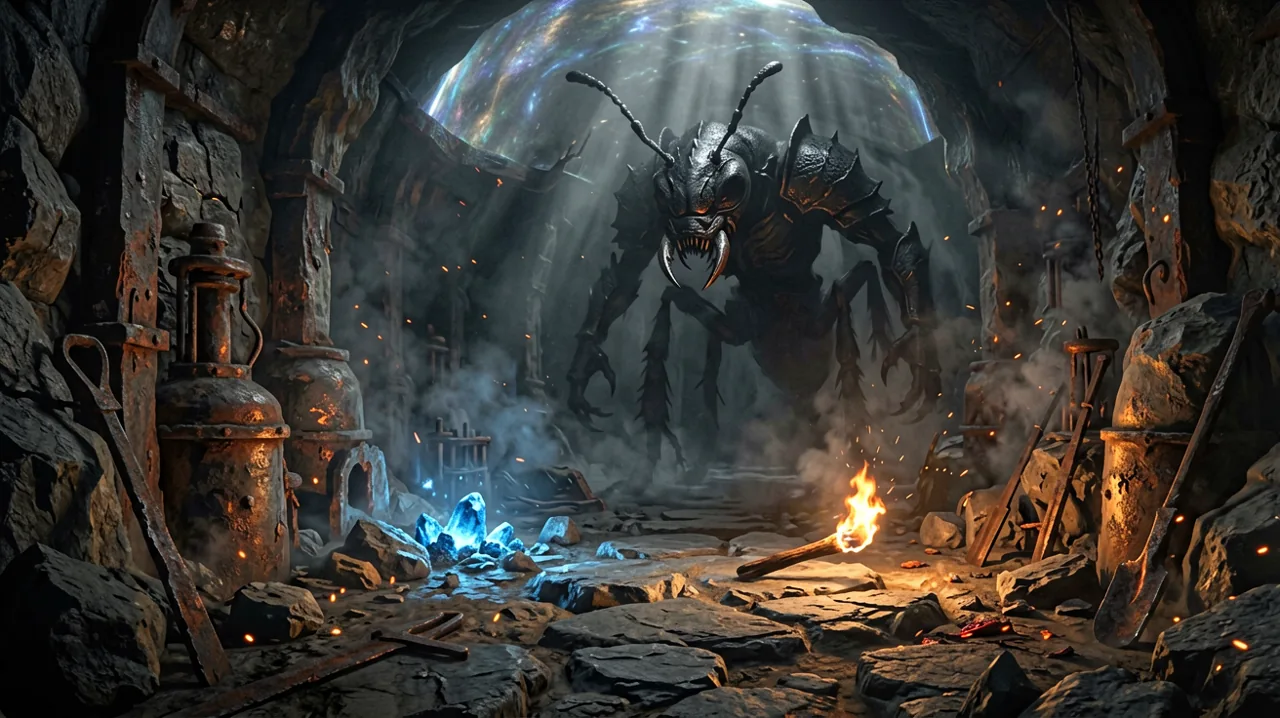
Down in the claustrophobic, damp depths of the Old Mine, players are encountering a threat that is testing their psychological limits. A recent thread on the /r/worldofgothic subreddit titled simply “Minecrawlers” has garnered significant attention, with players openly admitting that the newly redesigned creatures are giving them the “heebie-jeebies.” In fact, the visual terror is so potent that several users are actively requesting an arachnophobia enemy-replacer mod to swap the monsters out for something less intimidating.
In the original 2001 release, Minecrawlers were certainly a threat, but their low-polygon models, blurry textures, and rudimentary skittering animations limited their ability to induce genuine fear. They looked like oversized, blocky ants. Fast forward to 2026, and the developers have transformed these beasts into pure nightmare fuel. The new Minecrawlers feature sickeningly detailed chitinous plating, twitching mandibles, and multiple jointed legs that react dynamically to the uneven geometry of the mine walls.
For players suffering from arachnophobia or entomophobia (the fear of insects), venturing into the Old Mine is proving to be a monumental hurdle. The horror is significantly amplified by the game’s incredible ambient sound design. Long before your torch illuminates a crawler, you can hear the dreadful clicking of its legs against the stone and its guttural hissing echoing through the dark, branching tunnels. The lighting system exacerbates the tension; unless you have invested heavily in rune magic to cast sustained light spells, the deep, oppressive shadows obscure the crawlers until they lunge at you from the darkness.
Unfortunately for those wishing to avoid the dark depths, ignoring the Minecrawlers is simply not an option if you want to progress. These creatures are deeply woven into the lore and the colony’s ecosystem. Hunting them is mandatory to obtain crawler mandibles for alchemy, and you will eventually need to harvest their heavy shells if you plan on following our guide on how to get the Crawler Plate Armor. Furthermore, pushing deep into their nest to confront the monstrous Minecrawler Queen is a crucial mid-game milestone that cannot be bypassed.
While it is currently not yet confirmed if modders have successfully created a functional enemy replacer for the UE5 build, the demand is certainly there. Until then, we recommend grouping up with Templar NPCs when possible, keeping your torches lit, and relying heavily on ranged weapons and armor to keep these terrifying monstrosities at a safe distance.
Looking Ahead
As the player base continues to expand and dissect every corner of the penal colony, we can expect more secrets, community workarounds, and inevitable balance discussions to surface. The developers have shown a willingness to listen to feedback, and the community eagerly awaits future patches to address optimization quirks like the bizarre keyboard stutters. Regardless of the rough edges, the passion surrounding the game proves that the unforgiving spirit of the original Gothic is still very much alive and well in 2026. Keep your swords sharp, watch your pockets in the New Camp, and stay tuned for more updates from the Valley of Mines.